
Learning from bears in Romania
At Wild-Encounters, we believe that the best way to understand wildlife is to spend time observing it.
Our work has taken us to some of the Arctic’s most remote places, where we’ve spent years learning about polar bears and other wildlife. But there is always more to learn. So this time, we decided to broaden our experience and head south, into the Romanian Carpathians.
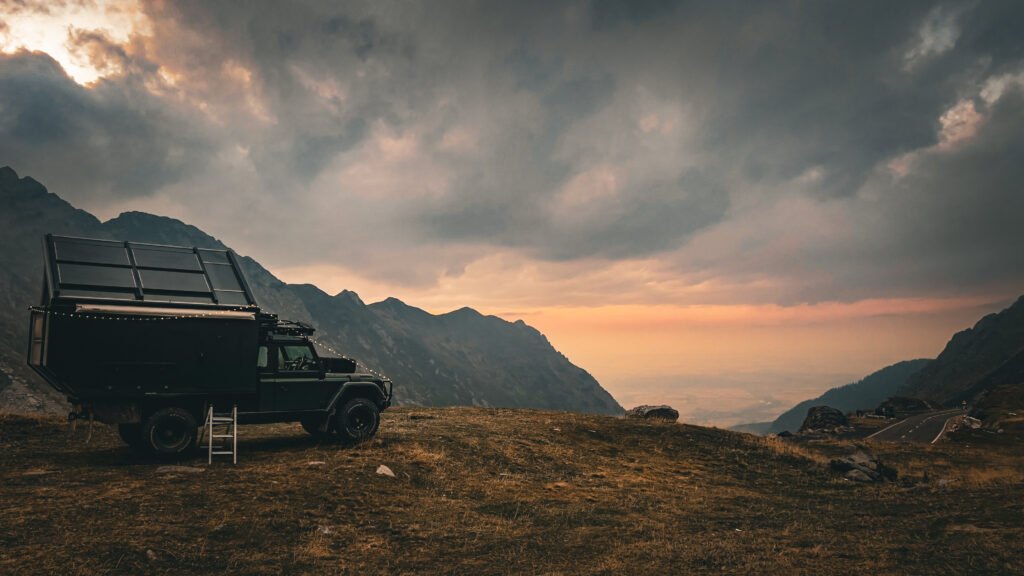
From the Netherlands, Romania is more than 2,000 kilometres away. That meant several days on the road, travelling in our Land Rover Defender a vehicle we’ve specifically adapted for observing wildlife in its natural habitat.
For us, those kilometres are never something to get through as quickly as possible. We genuinely enjoy being on the road together. With the Defender packed, a map in front of us and wild places ahead, the journey itself already feels like part of the expedition.
Once we arrived, however, we quickly realised that finding the bears wasn’t going to be easy.
The nights were getting colder and autumn was well underway. Along the famous Transfăgărășan, the bears were already starting to move towards the areas where they would spend the winter. Their movements were becoming less predictable, and simply knowing where bears had been seen before was no guarantee that they would still be there.
We had to be patient.
We had to be patient.
Fortunately, we got lucky. We were able to find two bears and observe them repeatedly over several days. That gave us something we value enormously in wildlife observation: time.
Seeing an animal once can give you a glimpse of its behaviour. Seeing the same individual over several days allows you to start recognising patterns, changes and responses to its surroundings.
But the bears themselves weren’t the only thing we were watching.
One of the most interesting parts of the experience was observing how the bears responded to the people who had clearly come to see them. These interactions raised many questions for us. How much distance did the bears choose to keep? Did their behaviour change when people approached? And how did they respond as the number of people around them increased?
Just as importantly, we were interested in what the people were doing and what those interactions might mean for the bears over time.
Wildlife doesn’t exist in isolation from us. Particularly with highly adaptable animals such as bears, the relationship between humans and wildlife can become an important part of their environment.
This is exactly why we believe field experience matters.
For us, wildlife interpretation isn’t simply about identifying a species or explaining what an animal is doing. It’s about understanding behaviour within its context, recognising when something changes, and knowing when our own presence should become less intrusive.
Sometimes the most valuable thing you can learn from an animal isn’t what it does.
It’s how we choose to respond.
And that is one of the reasons we’ll keep going into the field, to keep learning, questioning and becoming better wildlife interpreters ourselves.
FIELD NOTE
Repeated observations can tell us far more than a single wildlife encounter. By watching the same animals over several days, we can begin to recognize patterns, changes in behavior and the influence of their surroundings.